
Leveraging AI? It’s Time to Understand Growing Threats.
As AI becomes a key driver of business innovation, it introduces new vulnerabilities, particularly in the form of shadow AI and cyber threats. Discover how Forcepoint customers interact with AI to better understand its usage and how they are mitigating these risks.
August Briefing
July Briefing
June Briefing
May Briefing
April Briefing
March Briefing
February Briefing
January Briefing
The more AI The more AI applications,
the stronger the need for web security policies

Medium-sized businesses
Number of AI applications: 20
Deployed web policies for AI: 5
Large businesses
Number of AI applications: 40
Deployed web policies for AI: 8
Mid-level enterprises
Number of AI applications: 67
Deployed web policies for AI: 12
Large-scale enterprises
Number of AI applications: 93
Deployed web policies for AI: 17
August Briefing
#1 Mispadu malware attachment based campaign
Activity Dates: 1 Aug – 3 Aug
Targeted Sectors: Food & Beverage, Physical Security, Banking Logistics, Automotive businesses
Volume: 9,000+
Targeted Location(s): Mexico
- Attack Chain: EML → ZIP → HTML → ZIP → HTA → PS1 → Legitimate EXE → C2
- This campaign uses an invoice-themed phishing email as the delivery mechanism.
- The email, titled “Factura Folio: SCF-613254,” impersonates a legitimate business communication and contains a ZIP attachment named Archivo-20260730-255903.zip.
Subject: Factura Folio: SCF-613254
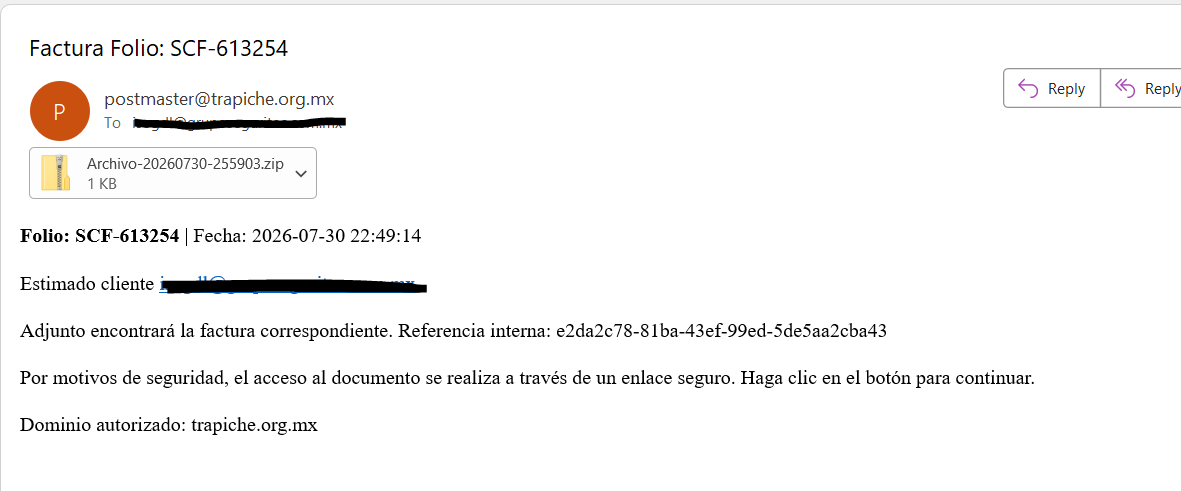
- The ZIP contains an obfuscated HTML file designed to appear as a legitimate document-access page. When opened, the file presents a “verified link” message and requires the victim to click a button to access the supposed invoice/document. The embedded JavaScript uses multiple layers of Base64 encoding and hexadecimal character decoding to conceal the next-stage URL, which is then opened in a new browser window.
- Following user interaction, the campaign progresses to an HTA/PowerShell execution stage. PowerShell is executed with its window hidden and used to retrieve the next-stage payload from external infrastructure. The downloaded payload is ultimately identified as Mispadu, an information-stealing malware written in Delphi.
- Once executed, Mispadu performs system, registry, language, and location discovery, establishes persistence through the Windows Startup folder, and attempts to access credentials stored by applications and browsers. The sandbox specifically observed activity associated with MailPassView and WebBrowserPassView, indicating an attempt to recover stored email and browser credentials.
- What makes it unique: Legitimate cloud infrastructure used for staging: The next-stage payload is hosted on a Supabase subdomain: hqrflcvifczglqtbukdu.supabase.co
- 85-9-207-79[.]de-fra1[.]upcloud[.]host (85[.]9[.]207.79) is an UpCloud Frankfurt VPS hostname reported as Mispadu/URSA banking trojan C2 infrastructure.
IOCs
- Dropper URLs: hxxps://hqrflcvifczglqtbukdu[.]supabase[.]co/storage/v1/object/public/kjdudhgdbnhh/AppAtual.jpg
- C2: 85-9-207-79.de-fra1[.]upcloud[.]host
Protection Statement
Forcepoint customers are protected against this threat at the following stages of attack:
- Stage 2 (Lure) - Malicious emails are blocked by Cloud rules. Archive attachments are detected by filetype.
- Stage 3 (Redirect/Dropper URL) — Dropper domains are classified under a security category.
- Stage 4 (Dropper File) - The dropper files are added to Forcepoint malicious database and are blocked.
- Stage 5 (Call Home) - Blocked C&C URLs
July Briefing
#1 German-language Bitcoin Extortion (Sextortion scam)
Activity Dates: 8 July
Targeted Sectors: Individuals in Germany and EMEA
Volume: 6,000+
Targeted Location(s): Germany and German-speaking EMEA (DACH region)
- A high-volume German-language extortion campaign was observed targeting recipients across the EMEA region.
- Attack Chain: Email (no payload) → Fear-based extortion note → Bitcoin wallet payment demand
- Broad, indiscriminate targeting of individual mailbox users across corporate and consumer environments.
- Payload-less extortion — the campaign contains no links or attachments, evading traditional URL/file-based detection and relying entirely on psychological manipulation (fabricated data-breach claims, payment deadline pressure) to monetize via untraceable Bitcoin payments.
- The messages follow the classic data-leak/sextortion extortion template: the sender claims to have compromised the recipient's device and exfiltrated personal data (browsing history, correspondence, photos/videos), then threatens to publish the material unless a ransom is paid in Bitcoin within a short deadline.
- No malicious attachment or URL is required — the attack relies purely on fear, shame, and urgency to pressure victims into direct cryptocurrency payment.
- The claims of compromise are unsubstantiated and part of a mass-mailed template.
- Subject: Ihre persönlichen Daten sind wegen des Verdachts auf schädliche Aktivitäten nach außen gelangt. (Translation: "Your personal data has been leaked due to suspicion of harmful activities.")
IOCs
- Envelope sender: kaba_86@hotello.de
Protection Statement
Forcepoint customers are protected against this threat at the following stages of attack:
- Stage 2 (Lure) - Emails are blocked by bulk detection and high spam scoring, and by MCRs.
#2 ValleyRAT (Silver Fox / SwimSnake–linked tradecraft) — Fake tax notice
Activity Dates: Throughout July 2026
Targeted Sectors: Corporate Finance account teams, tax professionals
Volume: 200+
Targeted Location(s): Russia, Japan, Malaysia and other APAC countries
- Attack Chain: Email → URL → ZIP → EXE → C2
- A tax-penalty-themed phishing campaign was observed delivering the ValleyRAT remote access trojan.
- Government/tax-authority impersonation timed around tax-season anxiety, combined with disposable .vip TLD dropper infrastructure rotated rapidly to outpace domain reputation systems.
- The staged delivery (URL → ZIP → EXE) keeps the email itself attachment-free, reducing static detection at the gateway.
- The lure pressures recipients with an alleged tax penalty/violation notice and directs them to an embedded URL.
- The link downloads a ZIP archive from attacker-controlled dropper infrastructure hosted on cheap, disposable .vip TLD domains.
- The archive contains an executable which, once run, establishes communication with the attackers' C2 infrastructure, giving them full remote access to the victim endpoint.
- This activity is consistent with the ongoing Silver Fox tax-themed ValleyRAT operations reported publicly through 2025–2026, which have impersonated national tax authorities (notably India's Income Tax Department) using near-identical
TAX/PEN/2026-*reference-number subjects, staged ZIP→EXE delivery, and rotating short-lived dropper domains.
Subject: No. TAX/PEN/2026-142204 "Invoice #INV-2026-0842 – Download Link 254"
IOCs
Dropper URLs:
- taobaoker[.]vip
- yonghengshijie[.]vip
- qvxzaetnb[.]vip
- eshggee[.]vip
- cgcvxxb[.]vip
- xuzhangxing[.]vip
- dadagaga[.]vip
File hash (SHA-1):
- c4a110f9e4904f86a2668d23971b0737328740d0 — ZIP archive
- 15a0eee558fc065f2aa556e65106c2f8c3171a10 — .exe
C2:
- qqdhq[.]cn
Protection Statement
Forcepoint customers are protected against this threat at the following stages of attack:
- Stage 2 (Lure) — Phishing emails are blocked by email analytics.
- Stage 3 (Redirect/Dropper URL) — Dropper domains are classified under a security category.
- Stage 5 (Dropper File) — Malicious ZIP/EXE payloads are blocked by file analysis.
June Briefing
#1 FIFA World Cup-themed campaign
Activity Dates: 20 June – 23 June
Targeted Sectors: Government, financial services, healthcare, transport, education, technology, retail
Volume: 900+
Targeted Location(s): Across Europe and APAC, U.K., Germany, Italy, Ireland, Sweden Australia, United States, UAE
World Cup-Themed Crypto Phishing Campaign Targets Stake Users
- Attack Chain: Phishing email → Vercel redirect URL → Phishing URL
- Threat actors are exploiting interest in the 2026 FIFA World Cup to lure cryptocurrency users into connecting their wallets to a malicious platform.
- The campaign impersonates Stake: Online Casino and Sports Betting site.
Subject: Turn your World Cup predictions into crypto yield, World Cup 2026 Token Farming is Live!
- Promotes a fake rewards program tied to World Cup betting activity.
Sample email:

- Recipients are encouraged to click a "Start Farming Now" button, which routes users through a Vercel-hosted redirect before ultimately landing on a fraudulent DeFi-style rewards portal. The use of a Vercel subdomain likely helps the campaign evade detection by some email security solutions due to the platform's trusted reputation.
- The final landing page presents users with an option to "Connect Wallet" in order to receive purported USDC reward distributions. However, connecting a wallet triggers a cryptocurrency drainer designed to initiate unauthorized asset transfers to attacker-controlled addresses. As blockchain transactions are irreversible, victims risk permanent loss of funds.
- This campaign demonstrates how threat actors continue to combine major global events, trusted cloud infrastructure, and Web3-focused social engineering techniques to increase the effectiveness of cryptocurrency theft operations.

IOCs
- Sending domain =rewards[@]web-stake[.]com
- Redirect (in email) = hxxps://ilvvtestetd[.]vercel[.]app/
- Drainer URL = hxxps://get[.]rpc-stake[.]com/farm
Protection Statement
Forcepoint customers are protected against this threat at the following stages of attack:
- Stage 2 (Lure) - Phishing/Spam emails were blocked by analytics.
- Stage 3 (Redirection) - Redirected Vercel URL is classified under a security category.
- Stage 4 (Phishing URL) - Crypto Wallet Drainer URL is classified under a security category.
May Briefing
#1 Multi-lure reward scam spam campaign
Activity Dates: 18 May – 20 May
Targeted Sectors: Public sector employees, private sector employees
Volume: 500,000+
Targeted Location(s): United States
- Attack Chain: Email → Lure link → Fake redirection → Credential harvest
- A large-scale email spam campaign asking users to participate in a survey and win lucrative gifts.
- Over 500K+ emails sent over a three-day period targeting business sectors in the United States.
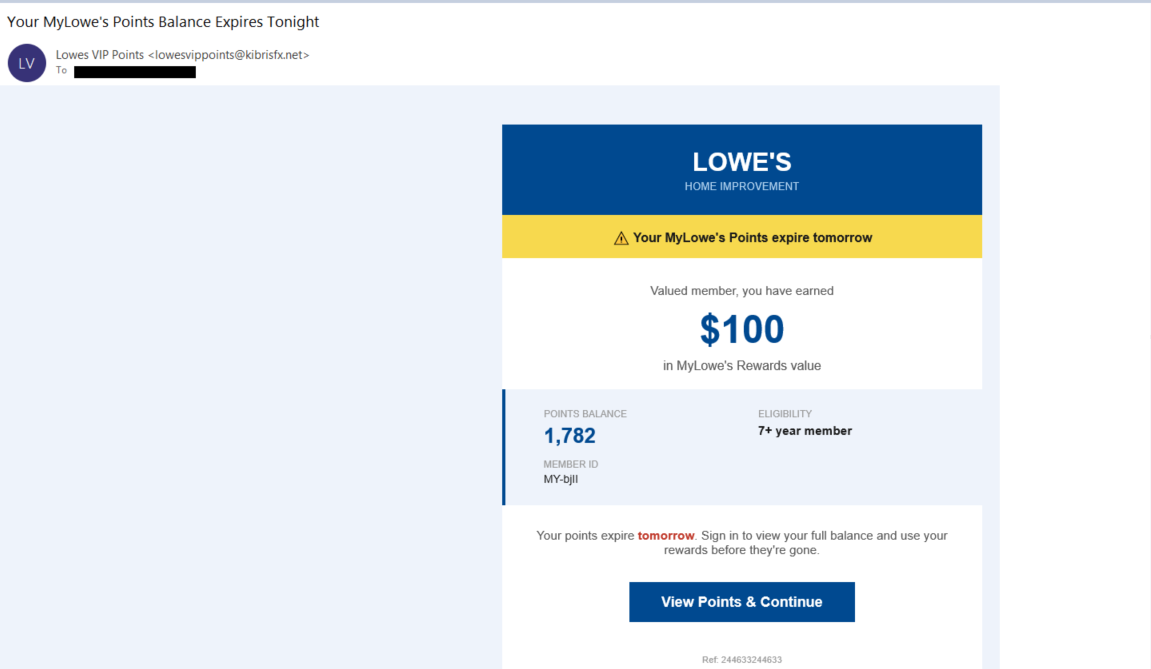
Subject: Your MyLowe's Points Balance Expires Tonight
- Email creates urgency claiming award points will expire.
- The email contains a lure of expiring reward points and to renew it to avoid losing points and creating urgency among users.
- Email also contains link to a portal where user can redeem points.
- The URL has lure and asks users to participate in a survey and to redeem reward points to win lucrative gifts.
- Once the user completes fake survey they are redirected to fake payment page where the sensitive credentials are harvested.
Sample email:
IOCs
URLS:
- hxxp://www.kibrisfx[.]net/regional/signals/s7l923
- hxxp://www.cosmomol[.]com/fresh-report-pulse/liveatlas/scicku7res8e75/watch
Protection Statement
Forcepoint customers are protected against this threat at the following stages of attack:
- Stage 2 (Lure) - Phishing/Spam emails are blocked by analytics.
- Stage 3 (Redirection) - Redirected URL is added under security category
#2 Google Calander invite phishing campaign
Activity Dates: 19 May – 25 May
Targeted Sectors: Australian, Fiji governments, United Kingdom local councils
Volume: 6,000+
Targeted Location(s): Australia, Fiji and the UK
- Attack Chain: Email → .ics / Support phone number → Customer support → Offers to cancel, refund the charge → Remote access → Stealing credentials
- This technique is an example of a Telephone-Oriented Attack Delivery (TOAD) or Callback Phishing attack.
- The email targets miscellaneous AV services renewal by either attending a meeting or giving a callback on the mentioned Support/Customer Care phone number.
- There were two scenarios observed: one in which an attached .ics file was present, and another which had the calendar invite embedded directly in the email’s body.
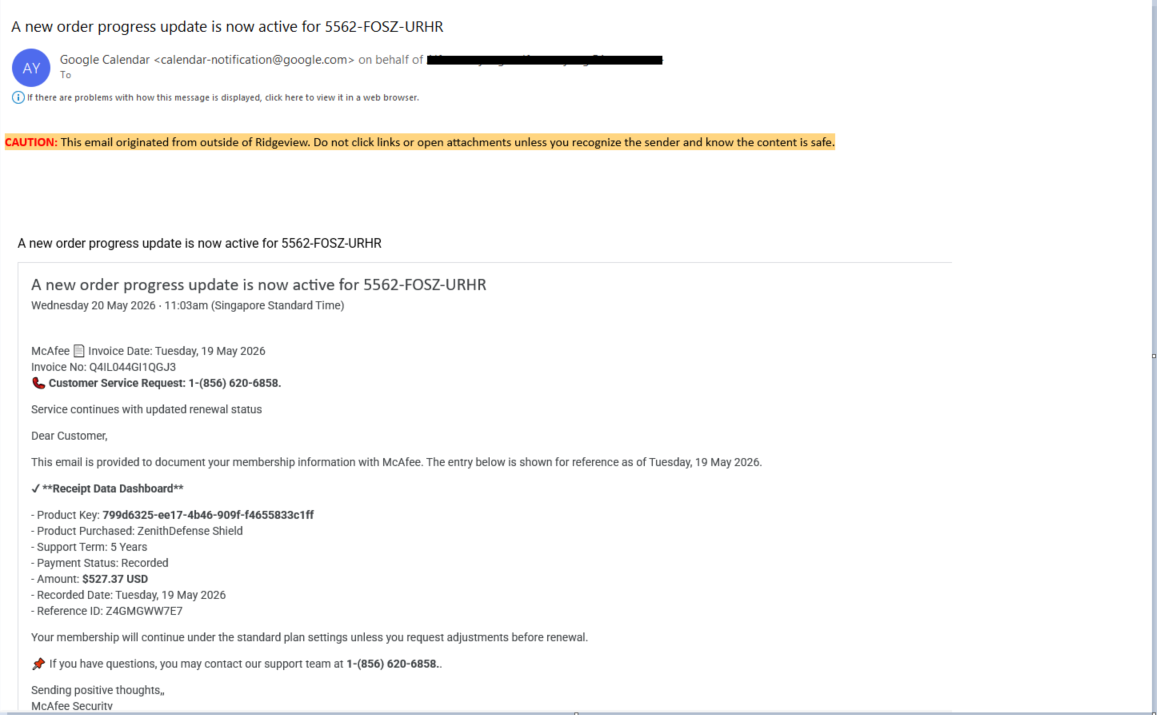
Subject: A new order progress update is now active for 5562-FOSZ-URHR
- The email follows a pattern mimicking an Antivirus Renewal request, complete with fake activation codes, phone numbers, and a specific amount due for activation.
- When the user attempts to contact the provided phone number, scammers attempt to collect sensitive credential information and steal funds from the victims.
Sample email:
IOCs
- 34ece4b8eb00273415994012c6a4e8273c60b237 - .ics file
Protection Statement
Forcepoint customers are protected against this threat at the following stages of attack:
- Stage 2 (Lure) - Spam emails are blocked by Cloud rules
April Briefing
#1: Vehicle tax payment phishing campaign
Activity Dates: April 27 - April 29
Targeted Sectors: Public sector employees, private sector employees
Volume: 10,000+
Targeted Location(s): United Kingdom
- Attack Chain: Email → URL→ phishing link
- A large-scale phishing campaign impersonating the UK's Driver and Vehicle Licensing Agency was detected with over 10,000+ emails sent to employees across UK public sector organisations, local authorities, financial institutions and private companies.
- A large-scale phishing campaign impersonating the UK's Driver and Vehicle Licensing Agency was detected with over 10,000+ emails sent to employees across UK public sector organisations, local authorities, financial institutions and private companies.
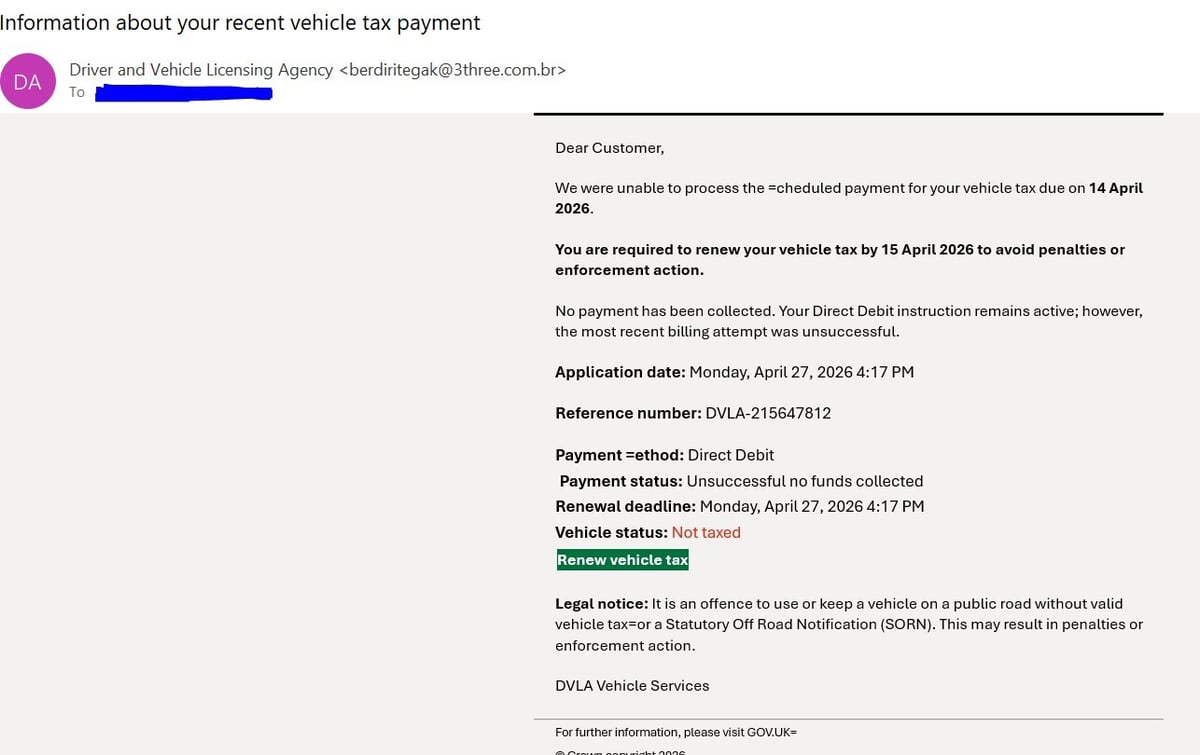
Subject : Information about your recent vehicle tax payment
- The campaign used multiple rotating senders aliases on a Brazilian domain (3three[.]com[.]br) to spoof DVLA branding while distributing send volume across aliases to bypass per-sender spam thresholds.
- The email impersonated an official UK government agency (DVLA) using convincing gov[.]uk branding, fabricated reference numbers, and a false "Not taxed" vehicle status to create fear and urgency, pressuring recipients into clicking the phishing link before a fabricated deadline.
- Embedded URLs redirectto newly registered domains.
- The threat actor registered or compromised five distinct mailboxes on 3three[.]com[.]br (a Brazilian domain), rotating sends across them to distribute volume and evade per-sender spam thresholds.
- Additionally, the phishing CTA URL was hosted on a compromised Indonesian local government subdomain (s[.]blitarkota[.]go[.]id) a legitimate .go.id (Indonesian government) domain likely chosen to evade URL reputation blocklists that typically trust government TLDs.
Sample email:
IOCs
URLS:
- hxxps://s[.]blitarkota[.]go[.]id/IXL2aT
- hxxps://s[.]blitarkota[.]go[.]id/BfLu0h
- hxxps://www[.]tyxcodes[.]com/
- hxxps://vechiletaxv12directdebitupdateemail[.]svpri[.]org/
Sender Domain:
- 3three[.]com[.]br
Protection Statement
Forcepoint customers are protected against this threat at the following stages of attack:
- Stage 2 (Lure) - Phishing emails were blocked by Spam scores.
- Stage 3 (Redirection) - Redirected URL is added under security category.
March Briefing
#1: DarkCloud HTML smug attachment-based campaign
Activity Dates: February 17
Targeted Sectors: Consumer end users
Volume: 120+
Targeted Location(s): Ireland
- Attack Chain: Email → HTML→ ZIP → EXE ->DLL
- This is a DLL Sideloading attack
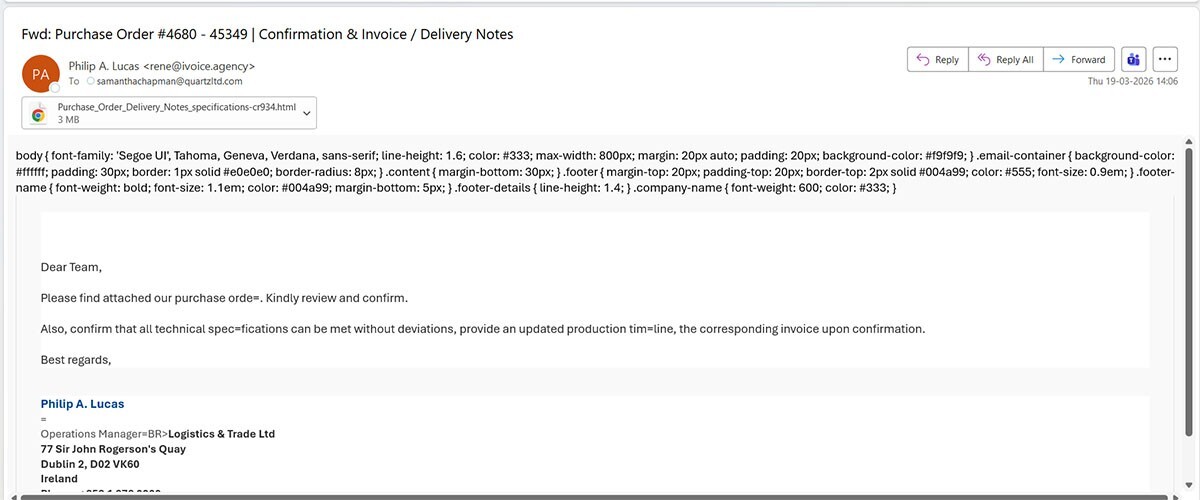
- The email requests the recipient to review an attached purchase order, confirm that all technical specifications can be met without deviations, provide an updated production timeline, and issue the corresponding invoice upon confirmation and having HTML file as attachment.
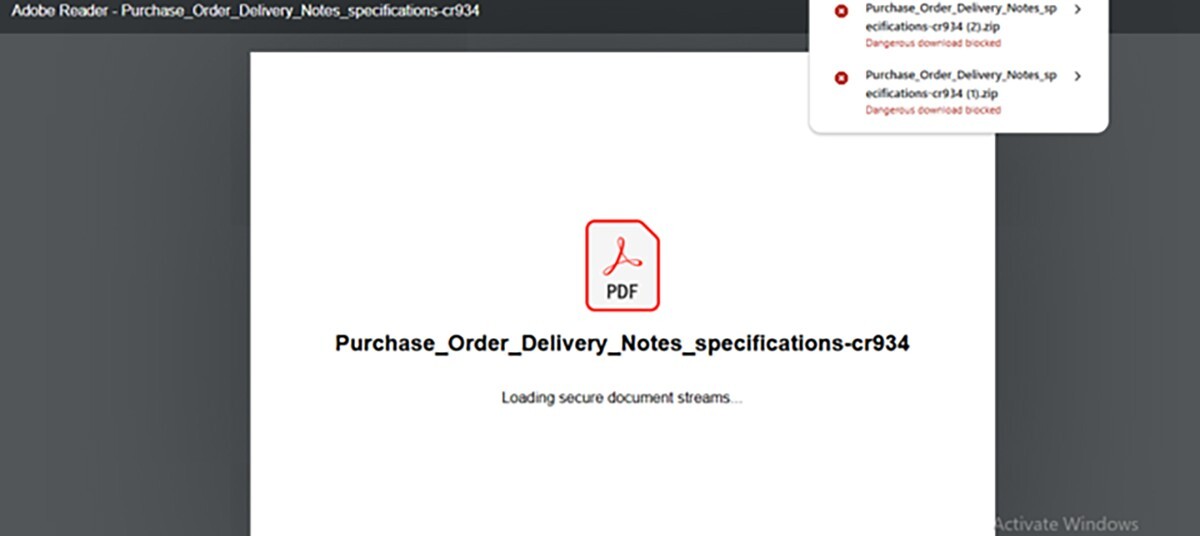
- When the victim attempts to open the HTML file, it silently downloads a malicious ZIP file in the background and redirects the user to legit adobe[.]com
Sample email:
- The malicious ZIP file contains an EXE and a DLL, where the EXE appears clean but loads the malicious DLL to carry out harmful activity.
IOCs
HTML: D6BB8D9F7EECBD709E3C622282D6E96EF797C5AE
ZIP: 42C36235E35DC3134B089F540444292AAB0A5DB7 -
DLL: F4EDBA4F1B1CB5D53608EE32164355F6EEE67F36
Protection Statement
Forcepoint customers are protected against this threat at the following stages of attack:
- Stage 2 (Lure) - Spam emails are blocked by Cloud rules
- Stage 4 (Dropper File) - The dropper files are added to Forcepoint malicious database and are blocked.
#2: SimpleHelp Remote admin tool URL based campaign
Activity Dates: 20 – 22 March
Targeted Sectors: Consumer end users
Volume: 220+
Targeted Location(s): Israel
- Attack Chain: Email → URL → EXE
- This technique is “living off trusted services” attack where hackers hide malicious files on legitimate platforms like GitHub so the link doesn’t look dangerous at first glance.
- The email is written in Hebrew and urges the recipient to “verify personal details” immediately to avoid delays in receiving a so-called security grant. It includes a call-to-action link directing the user to a personal area for verification. This creates a sense of urgency and leverages financial incentive to manipulate the recipient into clicking the following link:
- hxxps://github[.]com/nitzanigadi-rgb/RR/raw/refs/heads/main/Run-POLICE-0226[.]exe
Sample email:
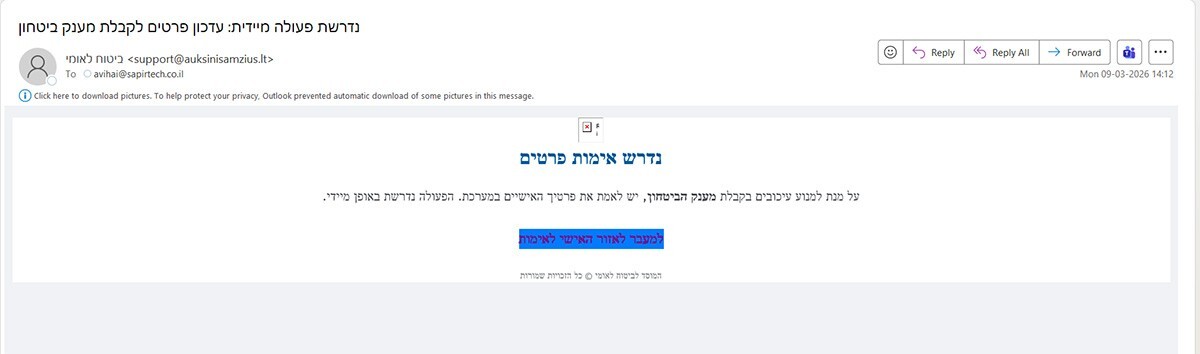
-
When the recipient clicks the link, it redirects to a malicious site that triggers the download of an executable file, which installs a remote access administration tool on the system.
IOCs
URLs:
Hash:
- hxxps://github[.]com/nitzanigadi-rgb/RR/raw/refs/heads/main/Run-POLICE-0226[.]exe
- SHA1 :61d4b61d6d483ed33995864ecd40ff1e1170834b
Protection Statement
Forcepoint customers are protected against this threat at the following stages of attack:
- URL blocked by Real Time Scanning
- Stage 4 (Dropper File) - The dropper files are added to Forcepoint malicious database and are blocked
February Briefing
#1: Epstein files email bait-and-switch campaign
Activity Dates: February 17
Targeted Sectors: Businesses
Volume: 3
Targeted Location(s): United States
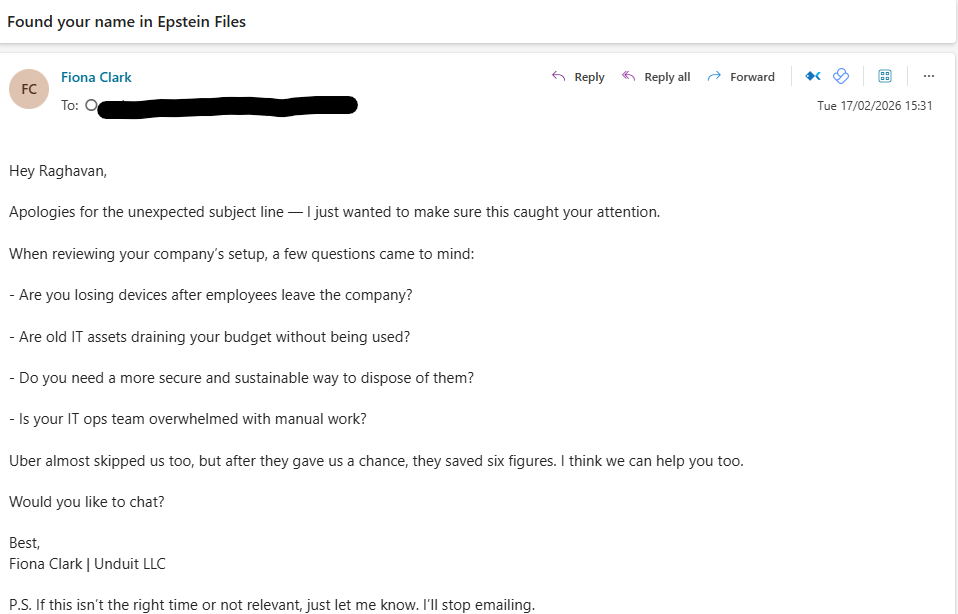
- Spammers are using a sensational and trendy subject line, such as ‘Found your name in Epstein Files’, to lure recipients into opening their emails. The body then includes an apology like ‘Apologies for the unexpected subject line — I just wanted to make sure this caught your attention.’ The rest of the message shifts into sales oriented questions and promotional content.
- Email claims to come from unduitham.com, but is actually sent via Salesforce Marketing Cloud bulk mail infrastructure (*.mta.salesforce.com, *.bnc.salesforce.com).
- Header contains X-SFDC-EmailCategory: apiMassMail X-SFDC-EmailCategory: apiMassMail
- Catchy subject: No legitimate communication would use mass-mail delivery with a personal, urgent, alarmist subject line.
Sample email:
IOCs
- Sender address fiona.clark@unduitham[.]com
Protection Statement
Forcepoint customers are protected against this threat at the following stages of attack:
-
- Stage 2 (Lure) - Spam emails are blocked by Cloud rules
#2: Free web hosting redirect campaign
Activity Dates: February 20
Targeted Sectors: General
Volume: 3
Targeted Location(s): Ukraine
- Campaign uses catchy name, an obfuscated JavaScript loader that reconstructs hidden code at runtime to perform browser redirects or load external resources
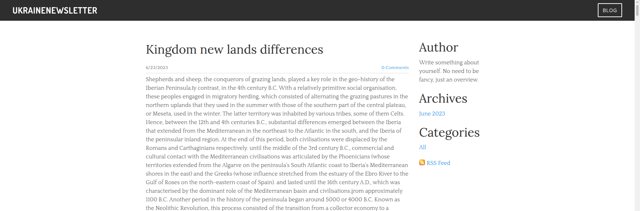
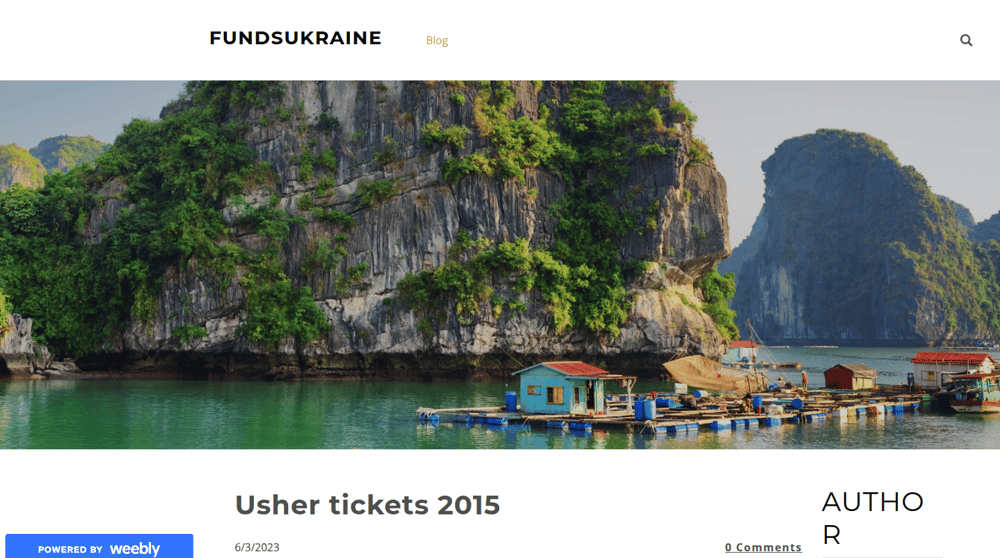
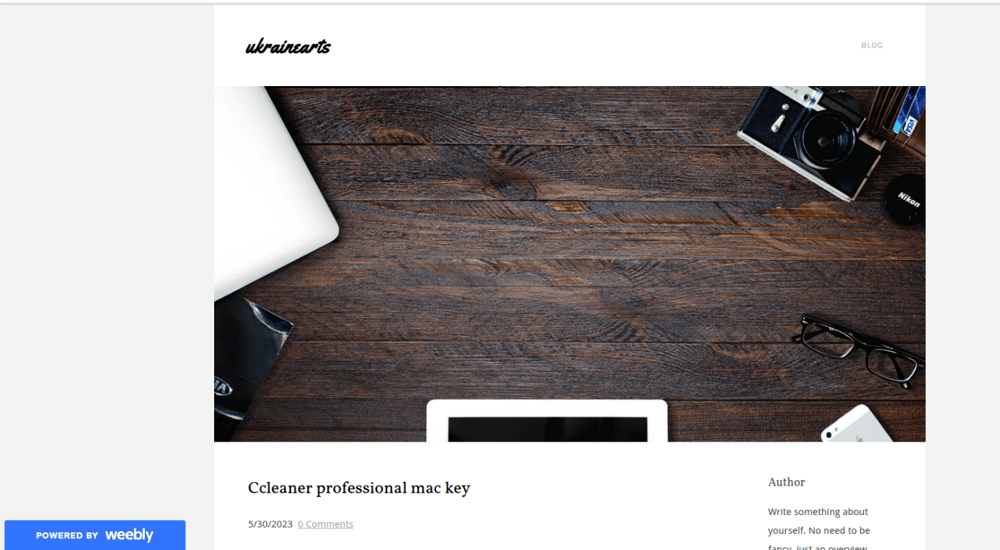
- Web pages containing Ukraine name and hosted on Weebly site
- hxxp://fundsukraine[.]weebly[.]com
- hxxp://ukrainenewsletter[.]weebly[.]com
- hxxp://ukrainearts[.]weebly[.]com
- The content of pages appears to be generic, non-Ukraine related blog posts, mainly about gaming, tech topics and other unrelated material.
- But code contains obfuscated JavaScript redirector used on SEO‑spam pages to secretly forward visitors to a malicious second‑stage site.
Ukraine campaign sample page 1:
Ukraine campaign sample page 2:
Ukraine campaign sample page 3:
IOCs
URLs:
- hxxp://fundsukraine[.]weebly[.]com
- hxxp://ukrainenewsletter[.]weebly[.]com
Protection Statement
Forcepoint customers are protected against this threat at the following stages of attack:
- URL blocked by Real Time Scanning (Live RTSS)
January Briefing
#1: Phantom Stealer attachment-based campaign
Activity Dates: 7 January – 26 January 2026
Targeted Sectors: Businesses, Governments and Banks
Volume: 3,000+
Targeted Location(s): United Kingdom, India and Pakistan
- Attack Chain: Email - > HTML-> ZIP - > BAT -> PS1 → Process Injection
- Phantom Stealer attacks were already surging in frequency and sophistication, and were still active as of January 2026.
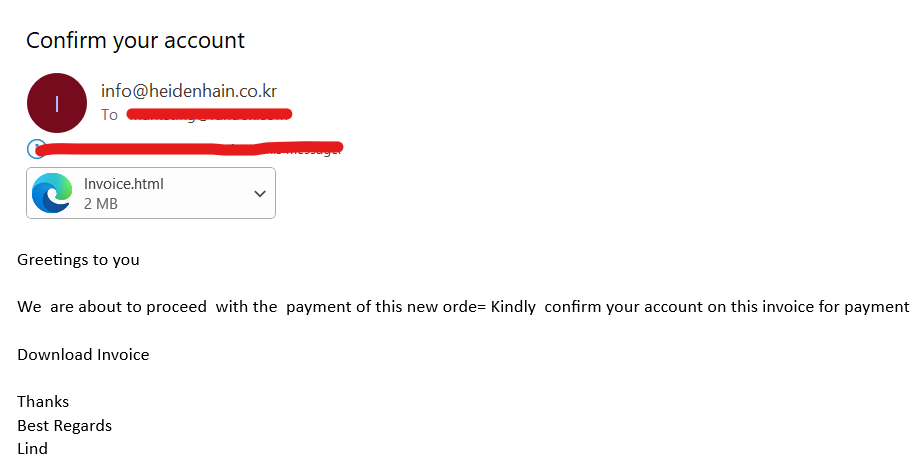
- Delivered via a malicious HTML attachment disguised as a B2B payment invoices.
- Email has HTML Smug attachment which contains embedded Base64 stream and JavaScript code. Once user opens HTML, it downloads a ZIP file that contains a BAT file. BAT further drops PowerShell and performs process injection targeting .Net processes.
- It scans nearby Wi‑Fi networks and displays detailed information.
- It launches Firefox and Chrome browsers with security and resource‑related restrictions disabled, while forcing it to use a temporary custom profile.
- Uses SMTP to exfiltrate data.
Subject Lines Used:
- Confirm your account
- Re: REVISED Purchase Order
- Payment Confirmation Copy
Sample email:
Hashes:
- 2F2E13A9B4B1177705A2F7137382E4B35EA06645 - HTML
- a91b5ddca78598e1e85bf7f1fbc855be879cf726 - BAT
- 4585a1b23eb51277056ec26926ac316788c23b45 - EXE
SMTP C2s:
- mail[.]grupomaspaq[.]com
- mail[.]poskirantekstil[.]com
- eraqron[.]shop
IOCs
Protection Statement
Forcepoint customers are protected against this threat at the following stages of attack:
- Stage 2 (Lure) - Malicious emails are blocked by Cloud rules. Archive attachments are detected by Yara.
- Stage 4 (Dropper File) - The dropper files are added to Forcepoint malicious database and are blocked.
- Stage 5 (Call Home) - Blocked C&C URLs
Why Securing AI Matters for Your Organization
AI brings tremendous value, but its risks cannot be ignored. Hence, organizations leveraging AI must ensure their data, applications, and infrastructure are secure to protect against the rising tide of cyber threats.
Steps You Can Take Today
- Audit your AI usage to understand potential vulnerabilities.
- Implement robust web security policies to mitigate risks.
- Partner with Forcepoint for AI-driven security solutions that protect your business at every stage of an attack.
Want to know more about how Forcepoint secures your AI usage and keeps your organization safe?